What Equipment Failures Actually Stop Voyages?

Not every equipment failure stops a voyage.
On any yacht, especially an older explorer yacht or offshore cruising vessel, something will always need attention. A pump may become noisy. A display may stop working. A domestic appliance may fail. A hatch may leak. A sensor may give an unreliable reading.
These things matter, but they do not all carry the same consequence.
One of the most useful questions an owner can ask is not simply:
“What could fail?”
It is:
“What failure would actually stop the vessel, create a safety problem, or force a change of plan?”
That distinction matters. Offshore readiness is not about having a perfect yacht. It is about understanding which systems are critical, which failures are manageable, and where preparation should be focused before extended cruising.
Failure Consequence Matters More Than Failure Itself
A failure on board can fall into several broad categories.
Some failures are inconvenient. They affect comfort, but the vessel can continue operating safely.
Some failures are operationally disruptive. They may not be dangerous immediately, but they can make the voyage harder, slower or less comfortable.
Some failures are voyage-stopping. They affect the yacht’s ability to continue safely or practically.
Some failures are safety-critical. They may require immediate action, diversion, outside assistance, or a decision to abandon the original plan.
The problem is that owners often spend a lot of time worrying about visible or familiar equipment while underestimating less obvious systems that are far more important offshore.
A broken television is annoying. A failed fuel supply system is a very different problem.
Main Engine Failure
For most explorer yachts and long-range cruising vessels, the main engine is the obvious voyage-stopping system.
If the main engine cannot be relied upon, the entire cruising plan changes.
Main engine failure does not always mean a catastrophic internal engine problem. In many cases, the engine itself may be fundamentally sound, but it is stopped by supporting systems.
Common causes of propulsion loss can include:
Fuel contamination
Blocked filters
Cooling system failure
Exhaust problems
Belt failure
Raw water pump issues
Electrical supply or control problems
Air in the fuel system
Overheating
Poor maintenance access
Alarm or sensor issues that cannot be confidently interpreted
For an older yacht, the question is not just whether the engine starts at the dock. It is whether the whole propulsion system is ready to run reliably for extended periods under load.
That includes cooling, fuel supply, exhaust, mounts, controls, instrumentation, spares and service history.
A main engine may be the headline item, but the supporting systems often decide whether it can keep doing its job.
Fuel System Problems
Fuel system issues are among the most important reliability concerns for offshore cruising vessels.
They are also easy to underestimate.
A yacht may have large fuel capacity and impressive range, but that does not automatically mean the fuel system is offshore-ready. The system needs to be clean, understood, manageable and serviceable.
Fuel-related problems that can stop or disrupt a voyage include:
Contaminated fuel
Water in tanks
Sludge disturbed in rough conditions
Blocked primary filters
Poorly labelled fuel valves
Unclear fuel transfer arrangements
Failed fuel lift pumps
Lack of spare filters
Inability to isolate or manage tanks
Unknown tank condition
The risk often appears when the vessel leaves calm marina use and starts operating in real conditions. Movement can disturb contamination that has been sitting harmlessly at the bottom of tanks for years.
This is why fuel management matters so much. It is not just about having enough fuel. It is about being able to supply clean fuel to the machinery continuously.
A reliable fuel system is one of the foundations of offshore readiness.
Cooling System Failure
Cooling systems are another common cause of serious machinery problems.
A main engine or generator may be mechanically sound, but if it cannot keep itself cool, it cannot continue running.
Cooling-related failures may include:
Failed raw water pump impellers
Blocked strainers
Collapsed hoses
Heat exchanger fouling
Failed thermostats
Corroded pipework
Air locks
Seawater leaks
Blocked intakes
Poor access for inspection or repair
Cooling failures are particularly important because they can escalate quickly. An overheating engine may force a shutdown, reduce manoeuvring options, or create further damage if not dealt with properly.
For offshore cruising, cooling systems should not be treated as minor service items. They are critical support systems.
Spare impellers, belts, hoses, clips and coolant are not glamorous, but they may matter far more than newer electronics.
Generator Failure
On many modern yachts, generator failure can be more serious than owners initially realise.
The main engine may move the vessel, but the generator often supports the yacht’s electrical life.
Depending on the vessel, generator failure may affect:
Battery charging
Navigation equipment
Refrigeration
Watermaker operation
Domestic systems
Pumps
Communications
Heating or air conditioning
Cooking arrangements
Lighting
Autopilot support
General habitability
A yacht with strong battery capacity, alternator charging, solar, inverter systems and good load management may be able to tolerate generator problems for longer.
A yacht that is heavily generator-dependent may not.
The important question is not simply:
“Does the generator work?”
It is:
“What happens if the generator stops working three days from support?”
That question quickly reveals whether the electrical system has resilience or whether everything depends on one machine continuing to run.
Electrical System Failure
Electrical problems can stop a voyage even when the engine is mechanically fine.
Modern yachts rely heavily on electrical systems. Navigation, communications, pumps, alarms, monitoring, starting systems, steering controls, charging systems and domestic services may all depend on reliable power.
Electrical failures that can become serious include:
Battery failure
Charging failure
Inverter/charger failure
Alternator failure
Poor connections
Corrosion
Overloaded circuits
Poor labelling
Unknown modifications
Lack of wiring diagrams
Critical equipment on poorly protected circuits
No clear emergency power plan
The difficulty with electrical problems is that they can be hard to diagnose at sea, especially if previous modifications are undocumented.
For older yachts, the concern is often not the age of the electrical system alone. It is the combination of age, additions, alterations, poor labelling and limited documentation.
An electrical system does not have to be perfect, but the owner or crew should understand what is critical, what is backed up, and what can still function if part of the system fails.
Steering Failure
Steering problems are among the clearest voyage-stopping failures.
If a vessel cannot be steered reliably, everything else becomes secondary.
Steering systems may include hydraulic components, pumps, hoses, rams, control systems, autopilot interfaces and emergency steering arrangements. On some yachts, stabilisers or other hydraulic systems may also interact with the wider hydraulic setup.
Important questions include:
Has the steering system been maintained?
Are there leaks or signs of deterioration?
Are hoses and fittings in good condition?
Is the emergency steering arrangement understood?
Has it actually been tested?
Can the vessel be controlled if the autopilot fails?
Are spare hydraulic fluid and basic repair materials carried?
Is the system documented clearly?
Emergency steering is sometimes treated as a theoretical requirement rather than a practical system. That is a mistake.
It should be understood before it is needed.
Autopilot Failure
An autopilot failure may not make the vessel physically unable to continue, but it can still become voyage-stopping in practice.
On a short coastal passage, hand steering may be manageable.
On a long offshore passage with limited crew, heavy weather or fatigue, losing the autopilot can become a major operational problem.
Autopilot failure affects:
Watchkeeping
Fatigue management
Passage duration
Crew workload
Safety margins
Ability to manage other problems
This is a good example of why equipment consequence depends on context.
The same autopilot failure that is merely inconvenient on a day passage may become a serious issue halfway through a long offshore leg.
Bilge Pumping and Flooding Control
Water ingress changes priorities immediately.
Bilge pumps, alarms, seacocks, through-hulls and flooding response equipment are not exciting systems, but they are fundamental.
Failures or weaknesses may include:
Non-functioning bilge pumps
Failed float switches
Poor pump capacity
No high-water alarm
Blocked strainers
Poor access to bilges
Unclear compartment arrangements
Seacock corrosion or stiffness
Hose failure
Lack of softwood plugs or emergency materials
No manual backup plan
The key issue is not just whether water is entering the boat. It is whether the crew can detect it, locate it, slow it, pump it and manage it.
A small leak discovered early may be manageable.
A leak discovered late because alarms failed or bilges were inaccessible may become a very different problem.
Fire Detection and Suppression Problems
Fire is one of the most serious risks at sea.
Fire-related equipment may not “stop a voyage” in the normal mechanical sense, but a failure in detection, suppression or response capability can turn a manageable incident into an emergency.
Important areas include:
Engine room fire detection
Fixed fire suppression systems
Portable extinguishers
Fire blanket availability
Fuel and electrical risks
Escape routes
Emergency shutdowns
Crew familiarity
Service dates
Access and compartmentation
Fire safety should never be treated as a paperwork exercise. Equipment needs to be present, suitable, in date, accessible and understood.
For offshore operation, the crew’s ability to respond quickly matters as much as the equipment list.
Navigation and Communication Failures
Navigation and communication failures do not always stop a vessel immediately, but they can force a change of plan.
The seriousness depends on location, visibility, traffic, weather, crew experience and backup arrangements.
Potential issues include:
Chartplotter failure
GPS failure
Radar failure
AIS failure
VHF problems
Antenna failure
Loss of satellite communications
Inadequate backup navigation
No independent power supply
Over-reliance on one integrated system
A modern integrated navigation system can be excellent, but integration can also create dependency. If too much relies on one display, one network or one power supply, a single fault may have a wider impact than expected.
Good offshore preparation includes backup navigation and communication arrangements that are realistic and understood.
Watermaker Failure
A watermaker failure may or may not stop a voyage.
For some vessels, it is an inconvenience. For others, especially on longer passages or remote cruising plans, it can become a serious limitation.
The consequence depends on:
Fresh water tank capacity
Crew size
Passage length
Climate
Alternative water sources
Conservation plan
Repair ability
Spare filters and parts
Whether the system has been run and maintained regularly
A watermaker is not a substitute for planning. Owners should understand how long the yacht can operate without it and what actions would be taken if it failed.
Refrigeration and Domestic System Failures
Refrigeration, cooking, heating, air conditioning and domestic equipment affect comfort and habitability.
They do not usually stop the vessel mechanically, but they can still influence the voyage.
For example, loss of refrigeration on a long passage may affect food planning. Loss of cooking arrangements may affect crew welfare. Loss of heating may matter in colder regions. Loss of air conditioning may be uncomfortable but not necessarily critical, depending on the operating area.
These failures need to be considered honestly, but they should not be confused with propulsion, steering, flooding, fire or power failures.
The question is:
“Does this failure create discomfort, or does it affect the safe and practical continuation of the voyage?”
Safety Equipment Problems
Safety equipment does not normally stop a yacht from moving, but it may stop a responsible owner from departing.
Expired, missing or unsuitable safety equipment can affect insurance, compliance, crew confidence and the ability to respond to emergencies.
Relevant items may include:
Life raft
Lifejackets
EPIRB
PLBs
Flares or approved alternatives
Medical kit
Man overboard equipment
Emergency lighting
Fire equipment
Jackstays and harnesses where relevant
A yacht may be mechanically capable of departure but still not properly prepared for the intended passage.
That distinction matters.
The Failures That Really Matter
For most explorer yachts and offshore cruising vessels, the failures most likely to stop or seriously disrupt a voyage tend to involve:
Propulsion
Fuel supply
Cooling systems
Generator and electrical resilience
Steering
Autopilot on longer passages
Bilge pumping and flooding control
Fire detection and suppression
Navigation and communications
Safety equipment suitability
Critical spares and repair capability
This does not mean other systems are irrelevant. It means these areas should receive particular attention when preparing for offshore use.
Redundancy Is Useful, But Only If It Works
Owners often talk about redundancy, but redundancy is only useful if it is practical, tested and understood.
A spare pump buried deep in a locker may not help if nobody knows how to fit it.
A backup GPS is useful only if it has power, charts and someone knows how to use it.
A second generator is valuable only if it is maintained and not dependent on the same weak fuel supply.
A spare filter is useful only if the correct tools, seals and knowledge are available to change it safely.
Offshore readiness is not about listing spare equipment. It is about making sure backup arrangements are realistic.
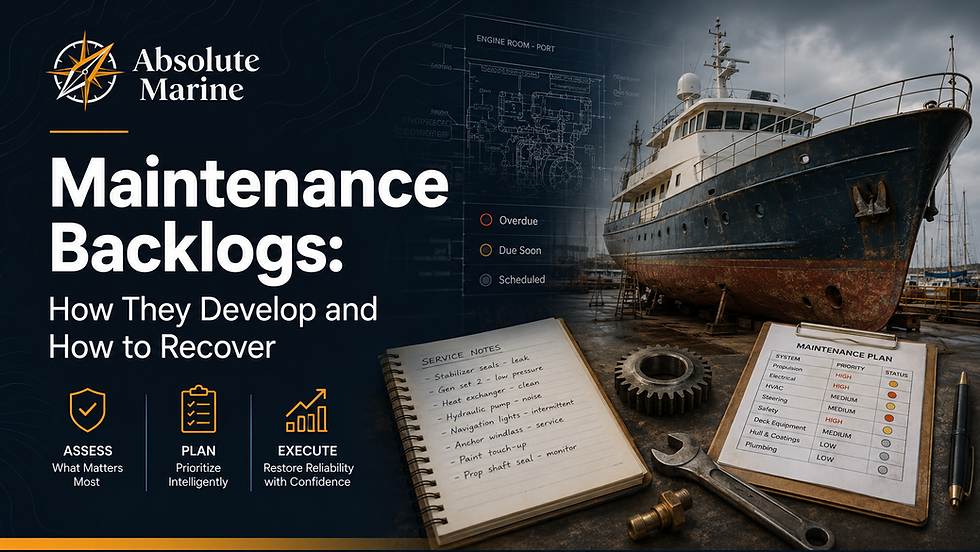
Maintenance Priorities Should Follow Consequence
Not all maintenance items should be treated equally.
When reviewing a survey report, maintenance list or preparation plan, the most important items are those with high consequence.
A cosmetic defect may wait.
A tired fuel hose may not.
An old cushion may be annoying.
A leaking seacock may be urgent.
A dated instrument display may be acceptable.
An unreliable charging system may not be.
This is where many owners benefit from separating maintenance into practical categories:
Safety-critical
Reliability-critical
Voyage-stopping
Comfort-related
Cosmetic
Future improvement
This helps avoid spending money in the wrong order.
The Question Owners Should Ask
Before offshore or extended cruising, owners should ask a simple set of questions for each major system:
What happens if this fails?
Can we continue safely?
Can we repair it on board?
Do we carry the right spares?
Do we have the tools?
Do we understand the system?
Is there a backup?
Has the backup been tested?
Would this failure force us to divert?
Would this failure become worse in poor weather or remote areas?
These questions are often more useful than simply asking whether a piece of equipment is new.
New equipment can fail.
Older equipment can be reliable.
The important issue is whether the system is suitable, maintained, understood and supported.
Final Thoughts
Equipment failures do not all carry the same consequence.
Some failures are inconvenient. Some are expensive. Some are uncomfortable. Some stop the vessel. Some create genuine safety concerns.
For explorer yacht owners and offshore cruisers, the aim is not to eliminate every possible fault. That is unrealistic.
The aim is to understand which failures matter most, reduce the likelihood of those failures, prepare sensible backups, carry appropriate spares, and make sure the owner or crew can respond when something goes wrong.
A yacht does not need to be perfect to be offshore-ready.
But the important systems need to be understood, maintained and treated with the seriousness they deserve.
That is the difference between a defect list and a readiness plan.
Our Services


Comments